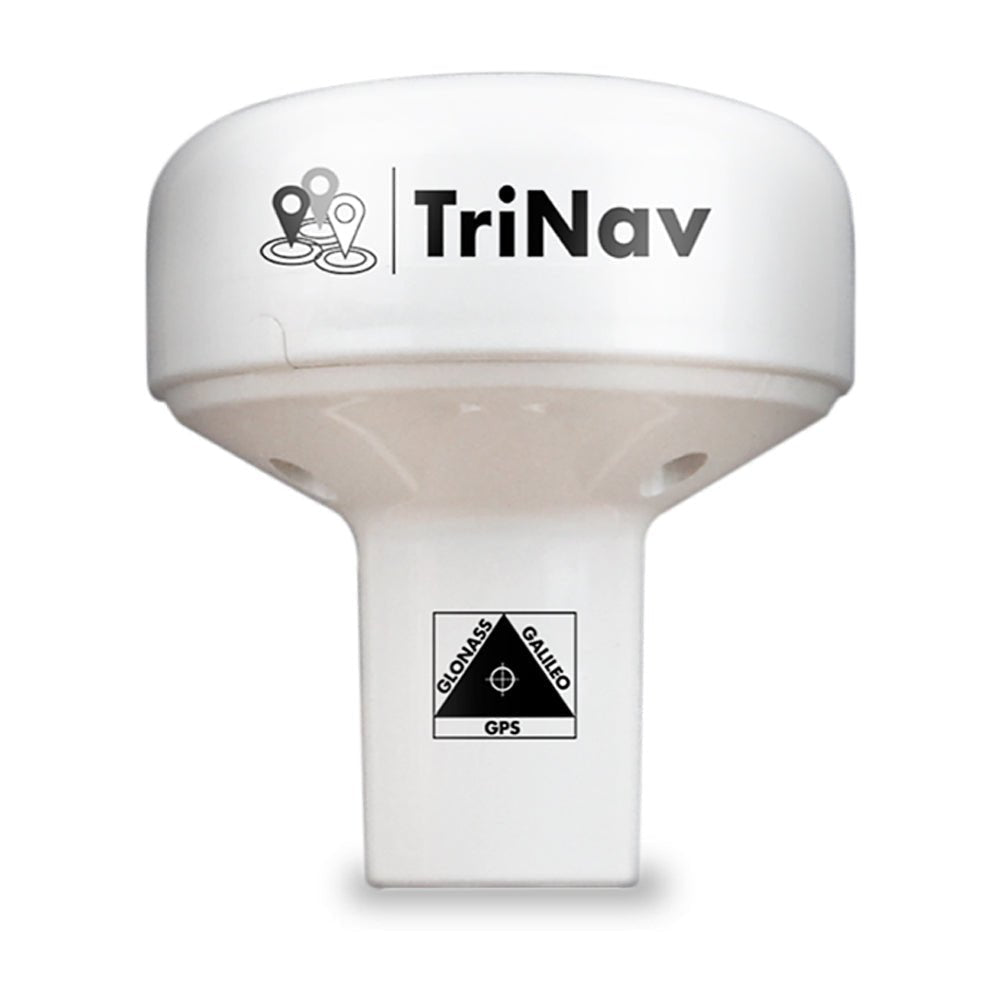
The Digital Yacht GPS160 TriNav GPS is a high-performance GNSS sensor designed for professional maritime systems. It blends GPS, GLONASS and Galileo to deliver precise positioning with built-in redundancy.
-
TriNav multi-constellation technology: Fuses GPS, GLONASS and Galileo to deliver optimum accuracy and redundancy.
-
72-channel GNSS receiver: 72-channel positioning receiver with TriNav technology for robust performance.
-
Typical accuracy: Better than 1 m.
-
Update rate: Up to 18 Hz for smooth plotter tracks.
-
Constellation configuration: Configurable as GPS only, GLONASS only, or Galileo only to suit your setup.
-
Anti-spoofing: Anti-spoofing algorithm for robust positioning performance and interference rejection.
-
Field-programmable interface: Internal DIP switches to configure baud (4800/38400/115200) and data formats, including datum information.
-
NMEA 0183 and datum support: Supports multiple NMEA 0183 data formats with user-configurable datum sentences (DTM/GBS/GNS/GRS/GSA/GST) for professional systems (ECDIS).
-
MOB capability: External switch input activates, generating a synthesised AIS MOB NMEA output for quick plotter indication.
-
Mounting options: Compatible with puck or standard 1" x 14 TPI mounting for flexible installation.
-
Power consumption: Ultra-low consumption — < 20 mA at 12 V DC.
-
Output options: NMEA 0183 output at 4800, 38400, or 115200 baud, or USB variant for PC, Mac and Linux.
-
NMEA 2000 compatibility: Bundled solution with the iKonvert NMEA 2000 gateway enables easy plug-and-play installation.
-
Included accessories: Includes 10 m cable for flexible mounting and connections.
-
ECDIS-ready datum support: Datum sentence structure tailored for professional ECDIS needs.
-
Galileo integration: Adds a third reliable GNSS source to enhance continuity and robustness at sea.
With multi-constellation coverage, spoofing resistance, and flexible output options, the GPS160 TriNav provides fast, reliable fixes for coastal, offshore, and critical ECDIS environments. It supports NMEA 0183 and NMEA 2000 networks, field configuration via internal DIP switches, and low power consumption for onboard reliability, making installation easy and ensuring safer, smoother navigation.